


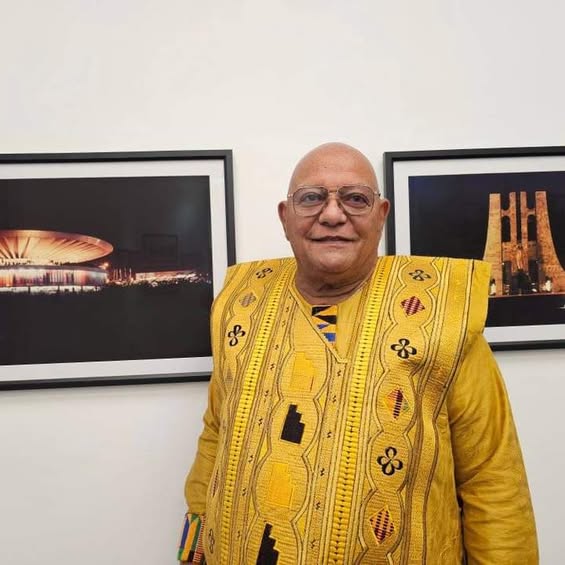

Celebrated Ghanaian Photographer Gerald Annan-Forson passes away
Tributes pour in for the man who captured the soul of a nation through his lens
A Nation in Mourning
Ghana and the global arts community are mourning the loss of Gerald Annan-Forson, the iconic photographer whose pioneering work defined the visual language of post-independence Ghana. His death was confirmed on Thursday, August 7, by Police Commander for Parliament House, Freeman Tettey.
Commander Tettey took to Facebook with a heartfelt message: “Rest well my senior friend Gerald Annan Forson,”—a sentiment echoed by many who knew and admired the legendary artist.
The cause of death remains unclear at this time.
A Life of Vision and Purpose
Born in London in 1947 to a Ghanaian father and Irish mother, Annan-Forson returned to Ghana in the 1970s with little more than a camera and a mission: to challenge the misrepresentations of Africa in global media. His lens became a powerful tool for storytelling—chronicling the daily lives, struggles, and triumphs of Ghanaians with grace and truth.
By 1976, he was working as a freelance photographer, and within a year, he had earned a press card from the Ministry of Information—giving him rare access to political events and public life during a time of national upheaval.
Chronicler of Ghana’s Political History
Annan-Forson documented some of the most pivotal moments in Ghana’s political history. He photographed the likes of Jerry John Rawlings and Hilla Limann, capturing behind-the-scenes glimpses of leadership transitions and state ceremonies. His now-iconic image of Rawlings handing over power to President Limann at Black Star Square in 1979 remains a cornerstone of Ghana’s visual archive.
His access was not coincidental. A schoolmate of Rawlings at Achimota College, Annan-Forson enjoyed unparalleled trust among Ghana’s political elite—though his work remained fiercely independent.
Courage Behind the Camera
Annan-Forson’s fearless commitment to documenting truth often came at a personal cost. During General Acheampong’s regime, he was arrested and interrogated after authorities mistook his camera lens for a bazooka. Fluent in multiple Ghanaian languages, he was even suspected of being a foreign agent. Despite the risks, he never wavered in his mission to portray Ghana with dignity and depth.
An Artistic Legacy Beyond Journalism
Gerald Annan-Forson’s work transcended traditional photojournalism. “His brilliance as a photographer is to find the subtle, intimate moments in the midst of daily life,” said Jesse Weaver Shipley, a professor at Dartmouth College and curator of Routes of Rebellion—Annan-Forson’s first U.S. retrospective currently showing at the Howard University Museum in Washington, D.C.
His photographs, deeply layered with social commentary, were not only about history but also about humanity. They’ve been exhibited across the world, including at the Sharjah Art Foundation and now in the United States.
A Mentor and Builder of Ghanaian Photography
In 1987, Annan-Forson co-founded the Ghana Union of Professional Photographers, creating a platform for mentorship and the professional development of younger artists. His commitment to the craft inspired generations, many of whom credit him with shaping Ghana’s modern visual identity.
Honored at Home and Abroad
Among his many accolades, one of the most personal to Annan-Forson was being chosen by the British High Commission to photograph Queen Elizabeth II during her 1999 visit to Ghana. For a man who once dreamed outside Buckingham Palace, it was a poetic full-circle moment. “They said, ‘We have been watching you. We’ve selected you from within Ghana,’” he recalled in an interview with ARTnews.
Remembering a Humble Visionary
Despite his global recognition, Gerald Annan-Forson remained grounded. “I never thought about getting credit or, for that matter, getting cash,” he once remarked. “I just wanted to show the beauty, struggle, and truth of Ghana.”
That legacy lives on through his images—portraits of resilience, snapshots of political change, and quiet moments that reflect a nation’s heartbeat.
A Lens That Never Closes
Though Gerald Annan-Forson has laid down his camera for the last time, his work will endure. His photographs will continue to educate, inspire, and ignite dialogue—ensuring that his voice, and the stories he captured, echo across generations.
Rest in power, Gerald Annan-Forson. Your lens never lied. Your legacy never fades.


DONATION TO SUPPORT THIS WEBSITE: 0599896099 +233599896099 Thank you for your contribution!


