



CJ removal process: Mahama receives probe C’ttee report
Article 146 Committee Submits First Report
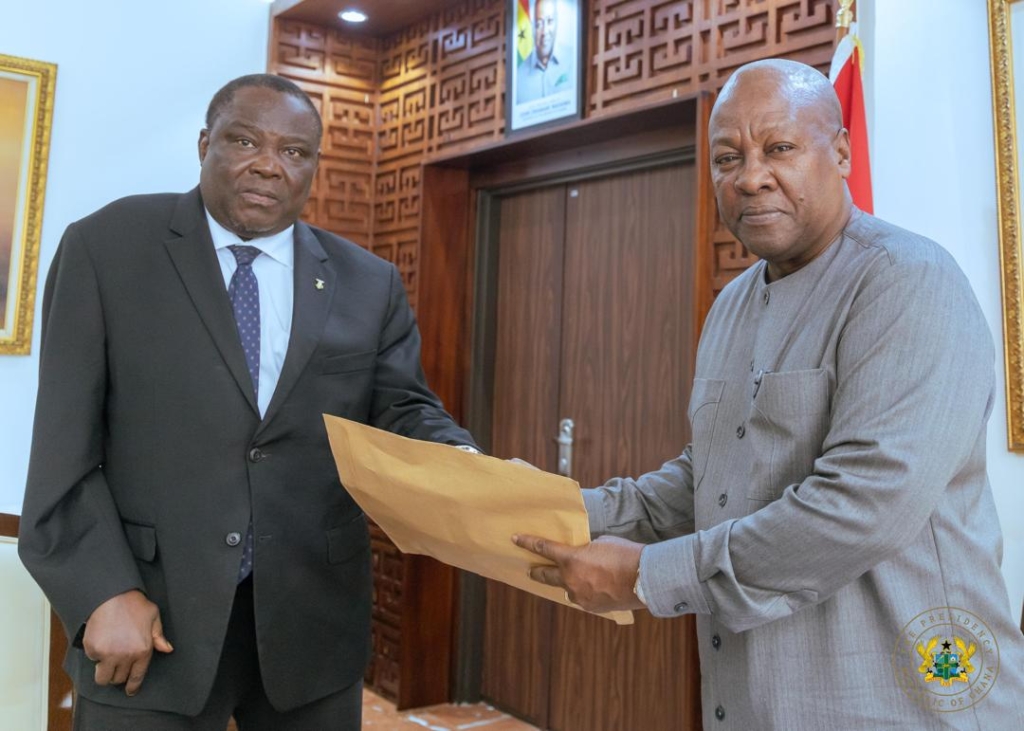
The Chairman of the Article 146 Committee of Inquiry, Justice Gabriel Scott Pwamang, has officially presented the Committee’s first report to President John Mahama on petitions seeking the removal of Chief Justice Gertrude Torkornoo.
The presentation took place at a brief but significant ceremony held at the Jubilee House, marking a critical step in the constitutional process triggered earlier this year.
Three petitions prompt constitutional action
Justice Pwamang revealed that in March 2025, three separate petitions were submitted to the President under Article 146 of the 1992 Constitution, all requesting the removal of the Chief Justice.
In accordance with the constitutional provisions, President Mahama promptly referred the petitions to the Committee for investigation.
In-camera proceedings begin in May
The Committee, inaugurated on May 15, 2025, held its proceedings strictly in camera, in line with constitutional mandates.
The first petitioner, Daniel Ofori, appeared before the panel and presented his case along with testimony from thirteen witnesses.
In a robust defence, Chief Justice Torkornoo also testified in person and called twelve witnesses, including expert witnesses. The legal teams on both sides—each comprising four lawyers—tendered approximately 10,000 pages of documentary evidence during the proceedings.
Chairman: ‘Fair and dispassionate assessment’
Addressing the media briefly at the ceremony, Justice Pwamang emphasized the impartiality and rigour of the Committee’s work.
“After critical and dispassionate examination and assessment of all the evidence presented before us, we have, without fear or favour, arrived at a recommendation on the first petition,” he stated.
The Committee’s sealed recommendation was then formally handed over to the President.
Adjournment on second petition
Justice Pwamang also disclosed that the second petitioner, in conjunction with the Chief Justice, had requested an adjournment concerning the second petition. That request was granted by the Committee.
Reports on the second and third petitions are expected to be submitted in due course as proceedings continue.
Transparency within constitutional limits
While proceedings were held in camera, as stipulated by law, the Committee stressed that the process was not conducted in secrecy.
Justice Pwamang reiterated that the Committee operated within the full bounds of transparency and constitutional due process.
“This process, though private in setting, was guided by principles of fairness, justice, and transparency,” he affirmed.


DONATION TO SUPPORT THIS WEBSITE: 0599896099 +233599896099 Thank you for your contribution!


