


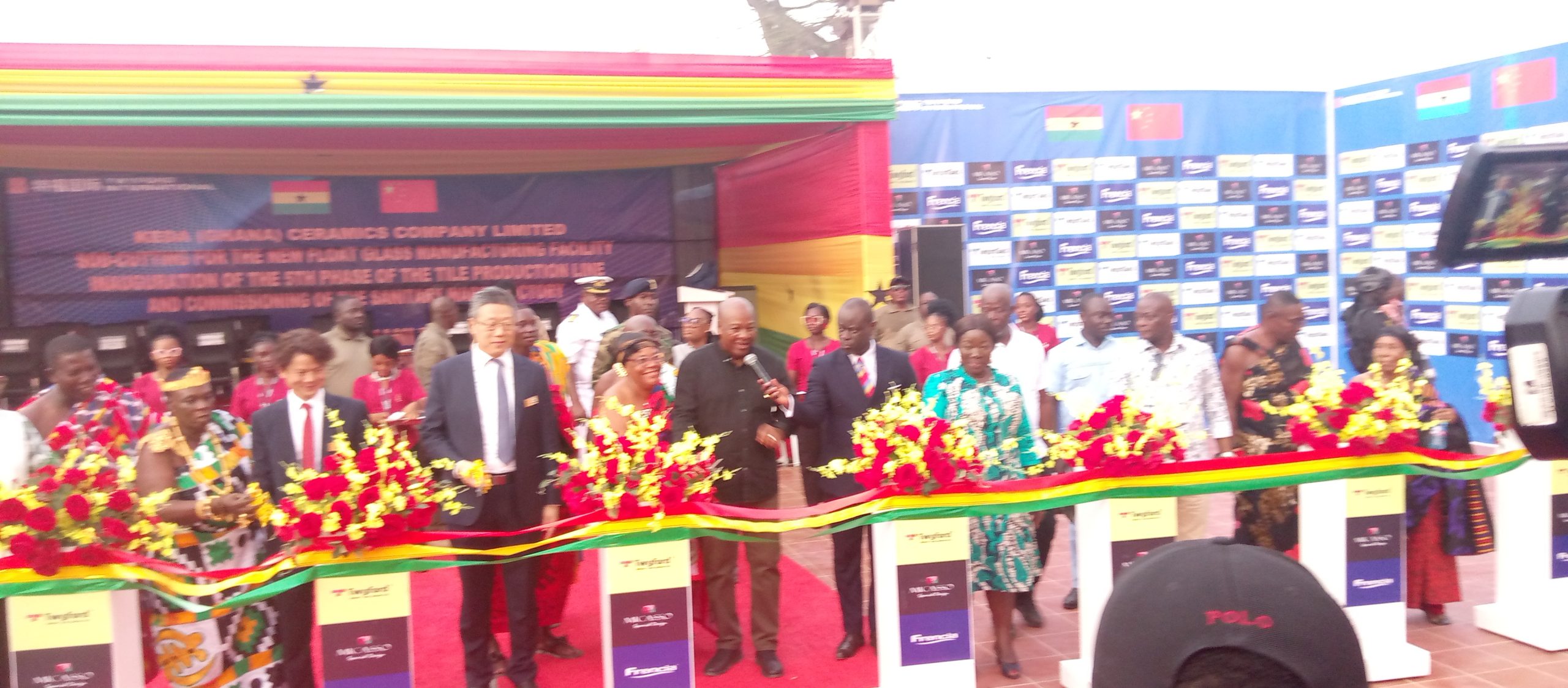

A new industrial dawn at Shama


In the quiet coastal enclave of Shama in Ghana’s Western Region, history was written in steel, glass, and ceramic. KEDA (Ghana) Ceramics Company Limited unveiled a bold new chapter in Ghana’s industrial journey — commissioning a state-of-the-art sanitary wares factory, inaugurating its 5th tile production line, and cutting sod for a float glass manufacturing facility.
The event drew dignitaries, business leaders, and community members, united by a shared vision: transforming Ghana into a manufacturing powerhouse in West Africa.
Presidential Endorsement: A “Game Changer” for Ghana
At the heart of the ceremony was John Dramani Mahama, who described the float glass facility as “a game changer for glass production in Ghana.”
Speaking at the sod-cutting ceremony, President Mahama emphasized that factories operating under the government’s 24-Hour Economy Authority would enjoy exemptions on import taxes for equipment brought into the country. According to him, this policy is designed to stimulate large-scale manufacturing and attract foreign direct investment.
He declared confidently:
“KEDA will become an industrial hub in the Western Region.”
The President tied the milestone to his government’s broader “reset agenda,” noting that Ghana has risen to become the 7th largest economy in Africa, overtaking Côte d’Ivoire. With Ghana’s GDP now at $113 billion and inflation reduced dramatically from 23.5% in 2024 to 3.8% in 2026, he described the ceremony as symbolic of economic stability and forward momentum.
Expanding Production, Expanding Exports
The numbers tell a compelling story.
KEDA now produces 2,000 square metres of tiles daily, exporting to 20 countries including the United States and France. With the addition of the sanitary wares factory and the upcoming float glass plant, Ghana’s presence in the global ceramics and glass markets is set to deepen significantly.
President Mahama further revealed that KEDA has already paid 740 million Ghana cedis in taxes, with projections to hit one billion cedis in the near future. He also announced plans for the construction of Shama Hospital — a major boost to local healthcare infrastructure.
Western Region Positioned as an Export Hub
Western Regional Minister Joseph Nelson welcomed the President and applauded KEDA’s growing impact.
He noted that the company’s operations would expand exports across the ECOWAS sub-region, strengthening Ghana’s trade footprint within West Africa.
“Your presence reflects your commitment to creating employment. Investment of this scale stimulates growth and industrialisation,” he stated.
For the Western Region — historically known for natural resources — the rise of manufacturing signals economic diversification and resilience.
KEDA’s Commitment to Ghana’s Development
Managing Director Li Wei described the day as proof of the company’s long-term commitment to Ghana.
He highlighted that KEDA is currently the only manufacturing company in Ghana exporting products directly to America and other international markets for foreign exchange earnings.
Beyond profitability, he stressed corporate responsibility:
- Projected tax contributions nearing one billion cedis
- Thousands of employment opportunities
- Staff accommodation packages
- Educational scholarships
- Community development initiatives
“Today’s event shows our commitment to Ghana’s industrialisation future and national development,” he affirmed.
The newly commissioned facilities, he added, are a direct response to growing market demand.
Strengthening Ghana–China Industrial Ties
Chairman of Twyford Group, Shen Yanchang, praised the Government of Ghana for ensuring macroeconomic stability and creating a business-friendly environment.
He commended President Mahama’s tax reduction policies and described Ghana as “open for business,” reaffirming the strength of Ghana-China relations.
“May God bless Ghana-China friendship,” he concluded.
Adding an international dimension, Elizabeth Ofosu-Adjare, Minister for Trade, Agribusiness and Industry, disclosed that Ghana and China are at advanced stages of signing new agreements to boost industrialisation in agro-processing, commerce, and manufacturing.
A Tour of Progress
Aside the formalities, President Mahama toured the tile production line and sanitary wares factory alongside Chairman Shen Yanchang, representatives from the Chinese Embassy, and members of the presidential media corps.
The hum of machines, the precision of automated systems, and the scale of operations painted a vivid picture of Ghana’s industrial future.
In a gesture of goodwill, KEDA donated items to schools, health centres, and community facilities in Shama — reinforcing its identity not just as a manufacturer, but as a development partner.
The Symbolism of the Sod-Cutting
The sod-cutting for the float glass manufacturing plant was more than ceremonial. It symbolized a shift — from dependence on imports to domestic production, from raw material exports to value addition, and from aspiration to execution.
As President Mahama noted, the event embodies the spirit of the economic reset agenda: stronger exports, a resilient Ghana cedi, improved social services, and sustained investment.
For Shama, for the Western Region, and for Ghana as a whole, the day marked not just the commissioning of factories — but the commissioning of confidence in the nation’s industrial future.


DONATION TO SUPPORT THIS WEBSITE: 0599896099 +233599896099 Thank you for your contribution!


