


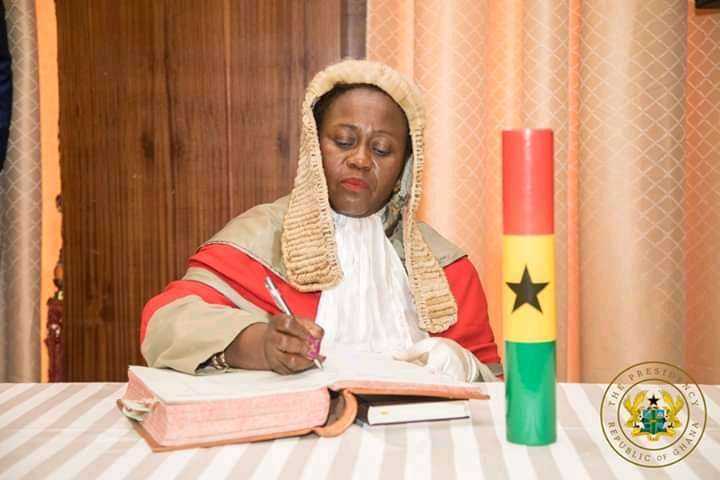

SC by 4-1 majority decision dismisses CenCES case against CJ’s suspension
In a landmark ruling that further defines the delicate balance between the executive and the judiciary, the Supreme Court of Ghana has, by a 4–1 majority decision, dismissed a case filed by the Centre for Citizenship, Constitutional and Electoral Systems (CenCES). The case challenged President John Mahama’s suspension of Chief Justice Gertrude Araba Esaaba Sackey Torkornoo and sought to halt the work of the committee set up to investigate her.
The panel’s verdict: A divided bench
The five-member panel of the apex court comprised Justices Paul Baffoe-Bonnie (Presiding), Issifu Omoro Tanko Amadu, Yonny Kulendi, Henry Anthony Kwofie, and Yaw Asare Darko. Justice Darko stood alone in dissent, as the remaining four upheld the President’s actions as constitutionally valid.
The majority ruling effectively paves the way for the committee of inquiry—chaired by Supreme Court Justice Gabriel Scott Pwamang—to continue its work in investigating allegations brought against the Chief Justice.
CenCES’ constitutional challenge
CenCES, a civil society group incorporated as a company limited by guarantee, filed the suit against three key figures: the Attorney General (1st Defendant), the Chief Justice herself (2nd Defendant), and Justice Pwamang (3rd Defendant), who also chairs the removal committee.
In their writ dated May 15, 2025, CenCES argued that President Mahama’s suspension of the Chief Justice contravened multiple constitutional provisions—chief among them Articles 125 and 127, which safeguard the independence of the judiciary. The group claimed the move amounted to executive overreach.
Seven-pronged reliefs and allegations of executive overreach
CenCES sought seven distinct reliefs, including a declaration that:
- The President’s suspension order was arbitrary and unconstitutional.
- A lawful prima facie case had not been established as per Article 146, rendering the investigative committee illegitimate.
- The ongoing proceedings infringe on the Chief Justice’s rights to fair treatment and due process under Articles 17 and 19.
Additionally, the group requested an injunction to halt all activities of the removal committee and urged the court to bar the Chief Justice from any role in the ongoing process, citing a potential conflict of interest.
Majority decision upholds presidential action
In rejecting CenCES’s petition, the majority of the bench found that the President acted within his constitutional mandate. The court maintained that the executive had followed the required processes and that CenCES had not sufficiently demonstrated any breach of judicial independence or due process.
Justice Yaw Asare Darko, the lone dissenter, expressed concerns about the implications of the ruling for judicial autonomy and the checks and balances enshrined in the 1992 Constitution.
Majority
Ag. Chief Justice Baffoe Bonnie
Justice Issifu Omoro Tanko Amadu
Justice Yonny Kulendi
Justice Henry Kwofie
Dissenting
Justice Yaw Asare Darko
Wider implications and ongoing legal developments
The decision is expected to shape future discourse on the powers of the executive in relation to the judiciary. Legal scholars and civil society actors are already debating whether the ruling sets a precedent for greater presidential influence over the judiciary.
Meanwhile, the Supreme Court is also currently hearing a similar case filed by private citizen Theodore Kofi Atta-Quartey. He is seeking an interlocutory injunction to pause the committee’s proceedings pending the outcome of his suit. His case, too, raises fundamental questions about the constitutional process for removing a sitting Chief Justice.
As the removal proceedings against Chief Justice Torkornoo continue, Ghanaians remain closely attuned to developments in what has become a highly sensitive and politically charged judicial matter. The Supreme Court’s decision in the CenCES case underscores the continuing tension between the need for judicial accountability and the imperative to uphold judicial independence in a constitutional democracy.

DONATION TO SUPPORT THIS WEBSITE: 0599896099 +233599896099 Thank you for your contribution!


