


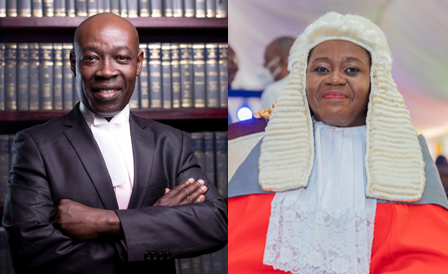

Thaddeus Sory questions suspended CJ: “What exactly did you respond to if you never received the petition?”
Date: 25th June 2025
Column: SHE SAID, WE SAY
Suspended CJ doesn’t know that Article 146 proceedings are held in camera?
A Moment of Reckoning for Ghana’s Judiciary
On the 25th of June, 2025, Lawyer Thaddeus Sory issued a robust critique in response to a public statement by Ghana’s suspended Chief Justice regarding Article 146 proceedings against her. While the suspended Chief Justice raised concerns about transparency, due process, and legality, Sory’s pointed rebuttal dissects each of her claims, underscoring long-standing precedents, constitutional boundaries, and the law’s impartial nature.
“Ripple Effects” Beyond the Individual?
She said: The proceedings under Article 146 against her “ripple far beyond [her] as a person.”
We say: Ghanaians need no lecture on the matter. We’ve seen this before. From Justice Paul Dery to Charlotte Osei, the precedent is well-trodden. Our legal landscape is rich with case law on this process—no ripples, just reflections of rule of law.
A Call for Public Hearings?
She said: She requested that the proceedings be public.
We ask: How could the nation’s suspended Chief Justice be unaware that Article 146 proceedings are, by settled Supreme Court rulings, held in camera? The apex court has affirmed this in:
- Justice Dery v Tiger Eye PI [2015-2016] 2 SCGLR 812
- Agyei Twum v Attorney-General [2005-2006] SCGLR 732
- GBA v Attorney-General [1995-96] 1 GLR 656
Every Article 146 inquiry before hers was private. Why this sudden call for a departure?
Complaints About Struck-Out Affidavits
She said: The Supreme Court erred in striking out her supplementary affidavit.
We say: Memory may serve her well. In an LGBTQI+ rights case, she herself ordered the striking out of an affidavit without pointing to any offending content. Furthermore, she approached the Supreme Court under its original jurisdiction, not to assert her fundamental rights—a domain that falls exclusively to the High Court.
Vague Allegations?
She said: She was not shown the specific allegations.
We ask: Then what exactly did she respond to during the prima facie inquiry? A determination can only arise from a set of responses to known allegations. Her claim contradicts the procedural facts.
Refusal of Witness Testimony?
She said: The committee declined to compel Daniel Ofori to testify.
We say: The law is clear. A party cannot be forced to testify. This is well established in:
- Nyame v Ansah [1989-90] 2 GLR 152 CA
- In Re Ashale Botwe [2003-2004] 1 SCGLR 420
Is this elementary rule unknown to our Chief Justice?
Spousal Attendance in Article 146 Hearings?
She said: Her husband was not permitted to attend.
We say: There is no precedent where a respondent’s spouse was allowed into such proceedings. The law has always maintained a strict boundary. Why should her case be an exception?
On the Venue of the Proceedings
She said: The location is unusual—a high-security zone at Castle Drive.
We say: Of course it is—this is the first Article 146 proceeding not conducted under her authority. The shift in venue is both symbolic and necessary.
Judicial Proceedings vs Inquisitorial Hearings?
She said: The hearing should be judicial.
We say: But Article 146 proceedings are inquisitorial, not judicial. The committee is not a court of law. The process is investigative—not adversarial.
No Copy of the Petition?
She said: She was not given the petitions.
We ask: Then what was she responding to? Her responses formed the basis of the prima facie decision. The claim is inconsistent with procedural reality.
Petitions Not in Evidence?
She said: The petition should have been formally tendered in evidence.
We say: In court, pleadings are not “put in evidence” to validate a trial. Similarly, in Article 146 proceedings, procedural documents form the groundwork—not evidence.
Misapplication of C.I. 65?
She said: The Committee should have followed the Commissions of Inquiry (Practice and Procedure) Rules, 2010 (C.I. 65).
We say: The definition section of that law excludes Article 146 committees. The Agyei Twum decision explicitly held that such committees are ad hoc and determine their own procedure.
Must Petitioners Have Direct Interest?
She said: Petitioners must show direct interest.
We say: In Charlotte Osei’s case, some petitioners were dead. Others had no personal stake, yet the case held. Procurement breaches—not personal grievances—led to her removal. The Agyei Twum case is clear: no locus standi is required for a valid petition against a Chief Justice.
The Bigger Concern: Legal Depth and Democratic Trust
We say: If there’s one sobering takeaway, it’s this: the Chief Justice’s statement reveals an alarming misapprehension of basic legal doctrines. Is this the individual who should steward our democracy’s justice system?
Final Word: A Betrayal of Constitutional Stewardship?
She said: Without her, there may be no justice.
We say: Justice is bigger than one person. The law stands firm regardless of who wears the robe. Such self-reverence betrays the very humility that true judicial authority demands.
Conclusion
Lawyer Thaddeus Sory’s response to the Chief Justice’s statement isn’t merely a legal rebuttal—it is a constitutional caution. When those entrusted with interpreting the law misunderstand or misrepresent it, the foundations of democratic justice are shaken. At stake is not a career, but public faith in the rule of law.

DONATION TO SUPPORT THIS WEBSITE: 0599896099 +233599896099 Thank you for your contribution!


