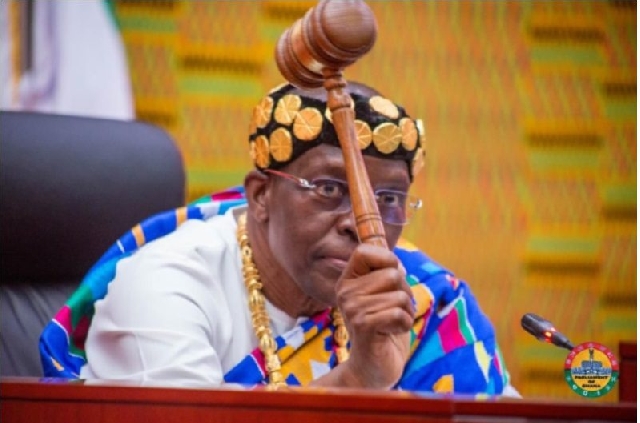

Anti-gay bill: Parliament ready for passage —Speaker
The air in Accra felt heavier than usual that April morning, as if the city itself had sensed what was coming.
Inside Parliament House, the corridors hummed with quiet urgency. Aides moved briskly, papers clutched to their chests, whispers trailing behind them like loose threads. At the center of it all stood Alban Bagbin—calm, resolute, and unmoved by the noise gathering beyond the chamber walls.
The day before, at a public forum, his words had landed like a stone dropped into still water: Parliament was ready. Ready to pass the bill again. Ready to finish what had already begun.
“I’m not a man of words. I’m a man of action.”
Now, those words echoed in the minds of many—supporters who felt vindicated, critics who felt a tightening knot of fear, and a nation caught somewhere in between.
Ama stood across the street from Parliament, her phone gripped tightly in her hand. Around her, a small crowd had gathered—some holding placards, others simply watching. She wasn’t there to shout. She wasn’t even sure she was there to protest. She was there because something about this moment felt final.
“They say it already passed once,” a man beside her murmured.
“It did,” another replied. “But the president never signed it.”
Ama knew that part. Everyone did. It had gone through all the stages—debates, amendments, votes. It had been, in every procedural sense, complete. And yet, it had stopped just short of becoming law, suspended in that quiet space between Parliament’s will and presidential assent.
But now, that pause seemed to be ending.
Inside the chamber, the mood was different—less uncertain, more deliberate.
Members took their seats, some with quiet confidence, others with measured restraint. The bill, though not yet formally laid again, lingered like a presence in the room. Bagbin adjusted his glasses and surveyed the House. To him, this was not chaos. It was process.
“The public must understand,” he had said the day before, “this is how Parliament works.”
And he believed that. Deeply.
To him, reintroducing the bill was not repetition—it was continuation. A step unfinished, now resumed.
Across the city, conversations unfolded in taxis, offices, markets, and living rooms.
Some spoke of values—of culture, tradition, and what they believed should define Ghanaian identity.
Others spoke of rights—of fear, of exclusion, of what it means to belong in a country that may soon legislate against your existence.
Radio stations buzzed with callers. Social media flickered with arguments. Facts tangled with misinformation, just as Bagbin had warned.
And yet, beneath all the noise, one truth remained:
Parliament was preparing to act.
As the sun dipped lower over Accra, Ama finally turned away from Parliament House. She didn’t know what would happen next—not really.
But she knew this: whatever came, it would not just be about law.
It would be about people.
About whose voices were heard. About whose lives were shaped by decisions made in rooms they might never enter. And about a country standing at a crossroads—between conviction and consequence.
Behind her, the Parliament building stood firm, unchanged.
Inside, history was getting ready to move again.