Disinformation in Africa: Local, regional, geopolitical impact and the role of Artificial Intelligence

Disinformation in Africa: Local, regional, geopolitical impact and the role of Artificial Intelligence
Across Africa, the rapid growth of internet access and social media has fundamentally reshaped the flow of information. While this digital transformation has enhanced civic participation and access to knowledge, it has also created fertile ground for disinformation, that is, deliberately false or misleading information spread to influence public opinion, behaviour, or political outcomes. Far from being a marginal issue, disinformation now poses a significant threat to governance, security, public health, and international relations. The emergence of Artificial Intelligence (AI) has further intensified this challenge, increasing both the scale and sophistication of disinformation campaigns.
Africa’s digital expansion is rapid but uneven. As of 2024, only 38% of Africa’s population has internet access, far below the global average of 68% (Punch Newspapers). At the same time, 84% of Africans rely on social media as their primary news source, increasing exposure to unverified information. Alarmingly, disinformation campaigns in Africa have quadrupled since 2022, reflecting the growing strategic use of false narratives across the continent (Zawya).
Conceptualising disinformation in the African context
Understanding disinformation in Africa requires grounding theoretical distinctions in lived realities. Misinformation refers to false information shared without harmful intent, such as an individual forwarding inaccurate health advice on social media. Disinformation, by contrast, involves deliberate manipulation, such as fabricated election results intended to suppress voter turnout. Malinformation describes genuine information used maliciously, for instance, through the strategic leaking of private communications to incite conflict. In African contexts, these categories frequently overlap. Oral traditions, communal communication patterns, and limited access to verification tools mean that misinformation can easily evolve into disinformation when amplified by political or economic actors. For example, a rumour originating in a religious or family WhatsApp group may gain legitimacy through trust networks before being strategically weaponized. A study titled “Misinformation Technology: Internet Use and Political Misperceptions in Africa”, based on Afrobarometer data across 35 countries, finds that internet use can reduce trust in government and reshape perceptions of democracy, highlighting how digital platforms can amplify misinformation and distort political understanding (ScienceDirect).
Historical foundations of information manipulation
Disinformation in Africa predates the digital age. During colonial rule, European administrations deployed propaganda to legitimize domination, portraying African societies as inferior and shaping both global and local perceptions. In the post-independence era, many governments centralized media control, particularly under military regimes, restricting dissent and reinforcing official narratives. These historical dynamics normalised information asymmetry and fostered reliance on informal communication channels, that is, conditions that persist in today’s digital ecosystems.
Local impact: Community-level Consequences
At the grassroots level, disinformation spreads rapidly through trusted platforms such as WhatsApp, community radio, and interpersonal networks. Its effects are often immediate and tangible. In Nigeria, false claims surrounding COVID-19 vaccines contributed to widespread hesitancy, undermining public health interventions. In Ghana, misinformation about electoral procedures has periodically generated voter confusion, weakening trust in democratic institutions.
More alarmingly, disinformation has contributed to violence. In Ethiopia, the circulation of misleading narratives and misattributed media has intensified ethnic tensions and fueled conflict. These examples underscore that disinformation is not merely a digital phenomenon; it produces real-world consequences that directly affect lives and livelihoods.
Regional dynamics: Cross-border spread
Disinformation in Africa operates within an interconnected regional information ecosystem. Narratives originating in one country frequently cross borders, aided by linguistic, cultural, and media linkages. In West Africa, coordinated campaigns have targeted multiple countries during election cycles, often recycling similar claims about electoral fraud. This suggests the existence of shared strategies or “playbooks.”
Regional organizations face significant challenges in responding effectively. For instance, disinformation related to security threats in the Sahel has undermined trust in both national governments and international partners, complicating counterterrorism efforts. The transnational nature of these campaigns highlights the need for coordinated regional responses.
Geopolitical dimensions: Africa as an information battleground
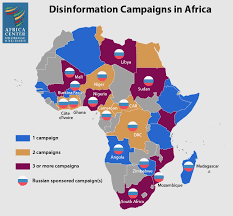
At the global level, Africa has become a critical arena for information warfare. External actors increasingly deploy disinformation to advance strategic, political, and economic interests. Competing narratives surrounding foreign military involvement in countries such as Mali and the Central African Republic illustrate how public opinion can be shaped through targeted campaigns.
During global crises (including the COVID-19 pandemic and the Russia–Ukraine conflict), African audiences have been exposed to tailored disinformation designed to influence diplomatic alignments and economic partnerships. These dynamics elevate disinformation from a domestic concern to a matter of geopolitical significance.
Artificial Intelligence: Risks and opportunities
Artificial Intelligence has transformed the disinformation landscape in profound ways. AI-driven tools enable the creation of highly convincing false content, including deepfake videos, synthetic audio, and AI-generated images. In contexts with low literacy levels, voice-based disinformation is particularly effective; fabricated audio messages attributed to trusted leaders can spread rapidly and provoke panic.
Additionally, automated bot networks can amplify misleading narratives, creating the illusion of consensus and increasing their credibility. AI also enables micro-targeting, allowing disinformation campaigns to tailor messages to specific ethnic, linguistic, or political groups.
However, AI is also a powerful tool for countering disinformation. Fact-checking organisations across Africa are increasingly leveraging machine learning to verify content, detect manipulation, and track the spread of false narratives. Despite this potential, significant gaps remain in technological infrastructure, funding, and expertise, limiting the effectiveness of these interventions.
Socio-cultural drivers of disinformation
Several socio-cultural factors contribute to the spread of disinformation in Africa. Trust is often rooted in personal relationships rather than formal institutions, meaning information shared by family members, religious leaders, or community figures is less likely to be questioned.
Furthermore, Africa’s linguistic diversity (comprising over 2,000 languages) creates substantial barriers for fact-checking initiatives, which are often limited to major global languages. Access to verification tools is also uneven, particularly in rural areas where digital literacy remains low. These conditions create an environment in which disinformation can thrive.
The political economy of disinformation
Disinformation persists because it serves powerful interests. Political actors frequently deploy it during elections to discredit opponents, suppress voter turnout, or inflame identity-based divisions. At the same time, foreign actors exploit information ecosystems to expand influence in strategically important regions.
Economic incentives also play a role. Digital platforms reward engagement, enabling the monetisation of sensational or misleading content. As a result, some content creators prioritise virality over accuracy, contributing (sometimes unintentionally) to the spread of disinformation.
Media literacy and civic resilience
Strengthening media literacy is one of the most effective long-term strategies for combating disinformation. Educational initiatives in countries such as Kenya and South Africa aim to equip citizens with the skills needed to critically evaluate information and identify falsehoods. However, these efforts require sustained investment and must be adapted to local contexts, particularly in underserved communities.
Policy and regulation: Balancing risks
Governments across Africa are increasingly implementing legal frameworks to address disinformation. While regulation is necessary, it carries significant risks. In countries such as Uganda and Tanzania, cyber laws targeting “false information” have raised concerns about potential misuse against journalists and political opponents.
The central challenge lies in balancing the need to curb harmful content with the protection of fundamental rights, including freedom of expression and press freedom. Overly restrictive measures may ultimately undermine democratic accountability.
Toward Information Integrity: A multi-level strategy
Addressing disinformation in Africa requires a comprehensive and collaborative approach. Governments must invest in digital literacy and support independent media. Regional bodies should strengthen cooperation and share intelligence on disinformation networks. Civil society organisations play a crucial role in grassroots education and fact-checking efforts, while technology companies must improve content moderation, particularly in African languages, and enhance algorithmic transparency.
Conclusion
Disinformation in Africa is a complex and evolving challenge shaped by historical legacies, socio-cultural dynamics, political interests, and technological change. The rise of Artificial Intelligence has intensified both the risks and the possibilities for response. Ultimately, addressing disinformation is not solely a technical or regulatory task; it requires building trust, fostering critical thinking, and strengthening institutional resilience. The future of Africa’s information ecosystem will depend on the ability of stakeholders to collaboratively promote truth, accountability, and informed citizenship in an increasingly digital age.