












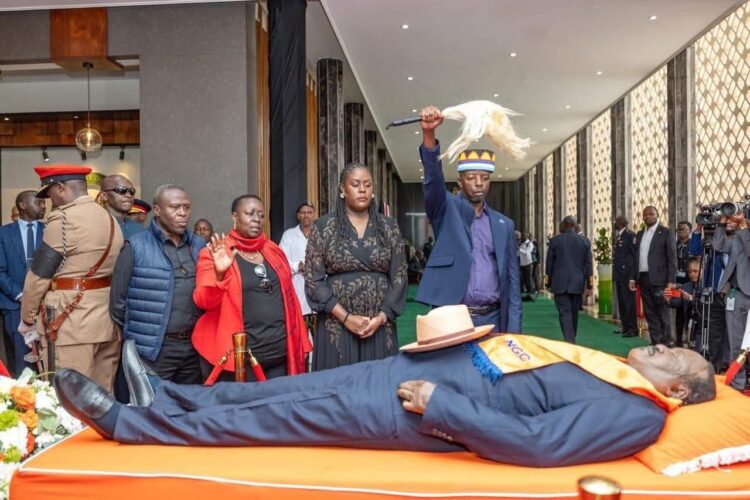
Kenya’s titan Raila Odinga laid to rest
A farewell to a giant
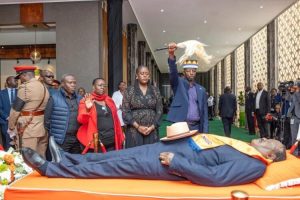
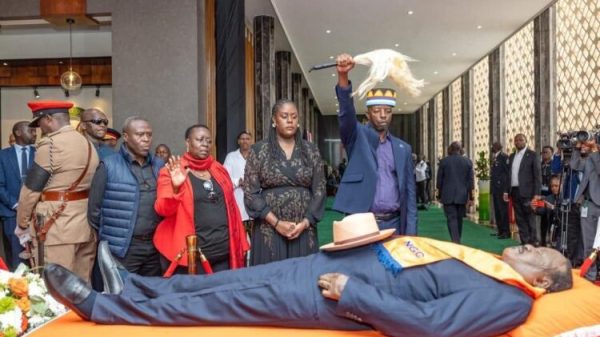
As Kenya and the world bid farewell to Raila Amolo Odinga, the country’s former Prime Minister lies in state, and the mood is solemn. The man whose life embodied Kenya’s turbulent journey to democracy has died at the age of 80 while undergoing treatment in India. His death not only marks the end of a towering political era but leaves a gaping void in both the opposition and national consciousness.
From his early days as a tortured dissident to his final years as a statesman seeking unity, Raila’s life spanned nearly six decades of Kenyan political history—rife with conflict, compromise, resistance, and reinvention.
Tortured dissident: A life forged in struggle
Born into political lineage as the son of Jaramogi Oginga Odinga, Kenya’s first vice president, Raila’s path seemed preordained. But it wasn’t privilege that defined him—it was resistance.
In 1982, following a failed coup against President Daniel arap Moi, Raila was detained without trial for six harrowing years. Tortured, blindfolded, and confined in the notorious Nyayo House, he suffered physical and psychological torment. Yet he emerged from those dark chambers not broken, but radicalised—a symbol of unyielding defiance.
His experiences in detention, chronicled in The Flame of Freedom, shaped him into a man who would go on to challenge authoritarianism with unmatched resilience. He would be jailed multiple times more, yet each time, his stature grew.
Defiance and pragmatism: The reluctant insider
In the 1990s, as Moi’s one-party state faltered, Raila helped usher in multiparty democracy. His charisma, oratory fire, and deep connection with the masses made him the voice of Kenya’s discontent.
From 1992 to 2022, he ran for the presidency five times—and lost each one. But his defeats were not in vain. In 2007, his most significant campaign ended in post-election violence that killed over 1,000 people. A historic power-sharing deal followed, placing Raila as Prime Minister under President Mwai Kibaki—a fragile but pivotal chapter in Kenya’s democratic evolution.
Critics accused him of losing his edge during this period. His pragmatism, though it brought stability, diluted the revolutionary image many had come to admire. Yet others saw this as maturity—a man who understood that governance required compromise.
Handshake politics and internal contradictions
Raila’s career took a dramatic turn in 2018 when he brokered a surprise handshake with his former rival, President Uhuru Kenyatta. It ended prolonged protests, but also blurred the traditional opposition-government lines, leaving his base confused and divided.
Together, they launched the Building Bridges Initiative (BBI)—a reformist but controversial attempt to reconfigure power and resource distribution. When the Supreme Court struck it down, it was seen as a major blow to Raila’s legacy.
His final political move came in March 2025, when he signed yet another unexpected working agreement—this time with President William Ruto, a man he had once fiercely opposed. For many, this was either the ultimate statesmanlike act of reconciliation—or the quiet surrender of a once-defiant revolutionary.
The darkest Scar: Collapse or compromise?
To some, Raila’s alliance with Ruto was a betrayal of the reformist cause he had long championed. For others, it was a mature effort to prioritise national unity over endless political contestation. Yet the impact was undeniable: it gutted the energy of the opposition and left his movement rudderless.
“He perhaps drew the darkest scar in his political career,” said analyst Ngala Chome, echoing a widespread sentiment that Raila had crossed a line his earlier self would never have considered.
Still, his continental impact was real. Between 2018 and 2023, he served as the African Union’s High Representative for Infrastructure Development—championing roads, railways, and integration across Africa.
A complicated legacy: Hero or hurdle?
To admirers, Raila was Kenya’s Mandela—a symbol of unbowed resistance and tireless pursuit of justice. He gave voice to marginalised communities and became the moral compass of a country navigating the minefields of tribalism, corruption, and contested elections.
To critics, he was an agitator who sometimes destabilised institutions for political gain. His shifting alliances and compromises left some questioning his consistency and commitment to reform.
“He fought dynasties but came from one. He championed the hustlers but dined with the establishment. Yet without him, Kenya’s democracy would be unrecognisable,” said one government adviser—capturing the contradiction that was Raila.
Unfinished battles and a shifting landscape
Raila’s final political ambition—to chair the African Union Commission—ended in disappointment earlier in 2025. His passing now opens up a profound vacuum, not just in ODM, but in Kenyan politics as a whole.
ODM, long synonymous with Raila’s image and charisma, now faces a crisis of identity and survival. There is no clear heir apparent. Independent analyst Rose Mumanya warns that ODM risks splintering under pressure:
“The biggest concern now is whether it can hold itself together, given the fragmentations we’ve already seen in the past year.”
His death may also shake Kenya’s broader political equation. President Ruto benefited politically from Raila’s cooperation—but without the balancing weight of Odinga, the country may enter a new phase of unrestrained political ambition and unpredictable alliances.
A legacy beyond the grave
Even in death, Raila’s influence will linger. His legacy will continue to spark debate: Was he a visionary or a pragmatist who made too many compromises? Did he elevate Kenyan democracy—or become too embedded in the system he once sought to reform?
The answers may differ, but what remains clear is that Raila Odinga shaped Kenya’s political history more than any other opposition leader in its post-independence era.
His was a life of resistance, reinvention, and resilience. And as the nation lays him to rest, it must now confront the challenge of charting its democratic future without him.
“Raila is gone,” says Mumanya, “but his ghost will haunt Kenya’s politics for a long time.”