
World Cup history as FIFA’s top 4-ranked teams reach semi-finals
2026 FIFA World Cup: Top 4-ranked teams make historic semi-Final Sweep
For the first time in FIFA World Cup history, the world’s top four-ranked national teams have all reached the semi-finals, marking a historic milestone in international football.
Spain (No. 1), Argentina (No. 2), France (No. 3), and England (No. 4) successfully navigated the group stage and knockout rounds to secure places in the final four. Their achievement is not only a testament to their quality on the pitch but also reflects a significant change FIFA introduced to the tournament’s draw system.
FIFA’s New Draw System Played a Key Role
The expanded 48-team World Cup prompted FIFA to redesign the tournament draw to ensure greater competitive balance. Under the new format, the top four-ranked teams were placed in separate sections of the bracket, preventing them from facing one another before the semi-finals—provided they each topped their respective groups. All four nations did exactly that, making the draw work precisely as intended. The arrangement also meant that tournament favourites Spain and Argentina could only meet in the final, while England and France were placed on opposite sides of the knockout bracket.
Semi-Final Line-Up Confirmed
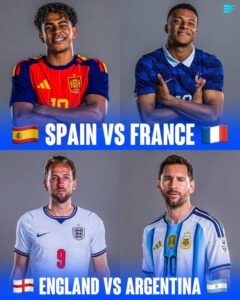
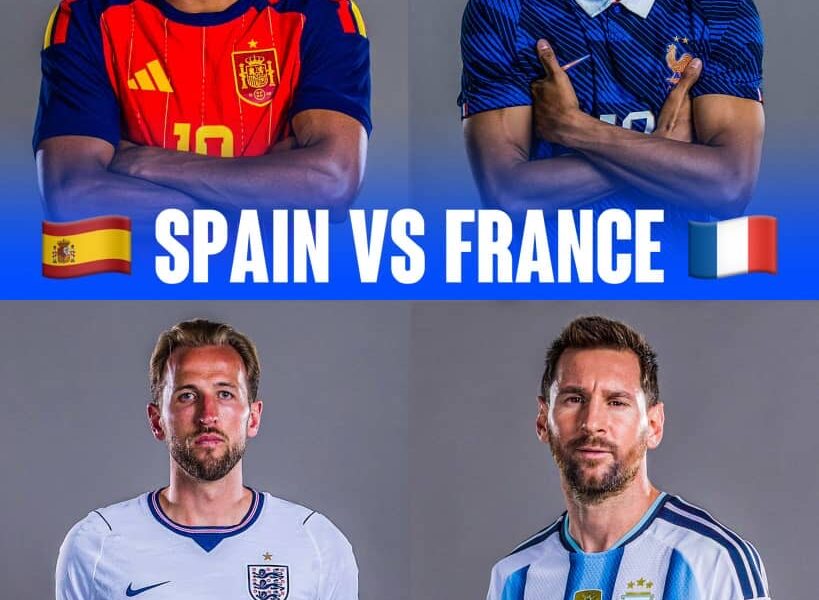
The carefully structured pathway has now produced two blockbuster semi-final clashes:
France vs Spain – Tuesday
England vs Argentina – Wednesday
The winners will battle for the biggest prize in international football in what could be one of the most anticipated World Cup finals in recent history.
FIFA Says the Change Ensures Competitive Balance
FIFA defended the revised draw process as a necessary adjustment to the expanded tournament. The governing body said the system was designed to create “competitive balance” by establishing “two separate pathways to the semi-finals,” ensuring that the highest-ranked teams would not eliminate one another in the earlier knockout rounds. The approach mirrors seeding systems used in other major sporting events, including Wimbledon and UEFA’s revamped Champions League format, where top seeds are deliberately kept apart until the latter stages.
Why the Change Became Necessary
In the previous 32-team World Cup format, group winners were naturally separated in the Round of 16, making early meetings between elite teams relatively uncommon. However, the expansion to 48 teams introduced an additional knockout round, significantly increasing the likelihood of group winners meeting before the semi-finals.
That concern became reality at the 2026 tournament, with several group winners facing each other as early as the Round of 16, including United States vs Belgium, England vs Mexico, and Switzerland vs Colombia.
To avoid marquee teams knocking each other out too early, FIFA opted to restructure the knockout bracket.
A Sharp Contrast to Previous World Cups
Since FIFA introduced its world rankings in 1994, the top-ranked teams have rarely dominated a World Cup in such comprehensive fashion. Several highly ranked nations have suffered shock early exits, including:
Belgium (2022)
Germany (2018)
Spain (2014)
Italy (2010)
France (2002)
In each case, teams ranked among the world’s top four failed to progress beyond the group stage.
Even in tournaments where the favourites advanced, all four of the top-ranked teams had never reached the semi-finals together.
FIFA’s Gamble Pays Off
According to analysts, FIFA was completely transparent about its intentions when introducing the new draw process. The governing body openly stated that it wanted to preserve blockbuster fixtures for the latter stages of the competition, ensuring the biggest footballing nations remained on separate paths for as long as possible.
A similar seeding principle had already been used during the FIFA Club World Cup, where top-ranked clubs were also separated in the knockout bracket.
This time, the strategy has delivered exactly the outcome FIFA envisioned.
Eyes on a Historic Finish
With Spain, Argentina, France, and England all still in contention, the 2026 FIFA World Cup is guaranteed to feature one of the tournament’s strongest-ever final fours. Whether the eventual champion is Spain seeking to cement its dominance, Argentina defending its global status, France chasing another world title, or England aiming to end decades of waiting, football fans are set for a dramatic conclusion to a World Cup that has already rewritten history.