Google Maps, the steering wheel and Regulation 132: Why L.I. 2519 needs a navigation exemption

Preamble
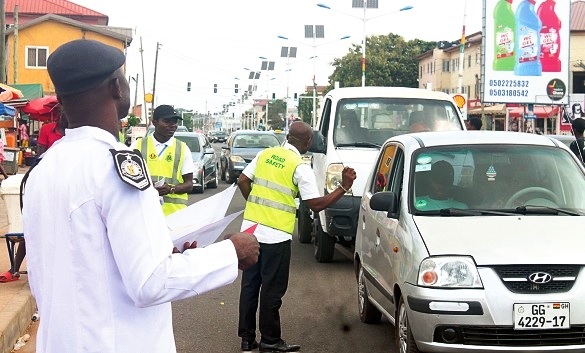
The Road Traffic Regulations, 2026 (L.I. 2519) were approved by Parliament on 28 May 2026, and the Ghana Police Service began full automated enforcement under its TRAFFITECH GH programme from 1 November 2026. The new framework deserves support. Ghana loses too many lives on its roads, and distracted driving is part of that story; research summarised by the World Health Organization (WHO) puts the crash risk of a driver using a mobile phone at about four (4) times that of one who is not. None of us would argue that drivers should be allowed to text, scroll or hold a phone to the ear while driving.
However, one provision, Regulation 132, has been written in a way that catches a very ordinary and largely safe behaviour: following directions on a phone. This piece examines what the regulation actually says, what it means for drivers who rely on Google Maps, Waze or ride-hailing apps, how comparable jurisdictions have dealt with the same question, and why a narrow amendment is now necessary.
What Regulation 132 says
Regulation 132(1) reads: “A person shall not drive a motor vehicle on a road or in a public place while holding, using or operating a cellular or mobile telephone or any other communication device in one or both hands.”
Regulation 132(3) defines a communication device as “a device, other than a two-way radio, which performs an interactive communication function by transmitting and receiving information.” Regulation 132(5)
(b) then provides that an “interactive communication function” includes sending or receiving oral or written messages; sending or receiving facsimile documents; sending or receiving still or moving images; and providing access to the internet.
The only exceptions are a call to the Police, Fire Service or other emergency service where it is unsafe or impracticable to stop (Regulation 132(4)), and officers of named emergency and security services acting in the course of duty (Regulation 132(6)). A contravention attracts, on summary conviction, a fine of not more than fifty (50) penalty units, imprisonment of not more than three (3) months, or both (Regulation 132(7)). At GH¢12 per penalty unit, the maximum fine is GH¢600.
It is worth noting that this wording is not new. Regulation 107(1) of the Road Traffic Regulations, 2012 (L.I. 2180) used substantially the same language. In other words, a provision drafted fourteen (14) years ago, before smartphone navigation became part of everyday driving in Ghana, has been carried into the 2026 regulations without being revisited. Has nothing changed on our roads in those fourteen years?
Does it cover navigation?
On a plain reading, yes. A smartphone running Google Maps or Waze is a communication device within Regulation 132(3): it transmits the vehicle’s location and receives map tiles, traffic data and rerouting instructions, and it does so by “providing access to the internet”, which Regulation 132(5)(b)(iv) expressly lists as an interactive communication function. The regulation makes no distinction between a phone used to chat on WhatsApp and the same phone used to find a clinic in an unfamiliar town.
The question therefore turns on the words “holding, using or operating … in one or both hands”. Three situations arise:
A driver who holds the phone in the hand to read directions commits an offence. This is clear, and it is the right position; a hand on the phone is a hand off the steering wheel.
A driver whose phone sits in a cradle fixed to the dashboard or windscreen, with the route set before the journey and spoken directions guiding the trip, is arguably outside Regulation 132(1), because the device is neither held nor operated by hand. The Motor Traffic and Transport Department (MTTD) has publicly taken this approach for Bluetooth calls, explaining that hands-free conversation is not in itself an offence while holding or operating the phone is.
A driver who touches a mounted phone, even once, to confirm a reroute or dismiss a prompt is in a grey area. Is a single tap “operating” the device “in one hand”? The regulation does not say, and a driver should not have to wait for a court to find out.
The uncertainty does not end there. Regulation 237(1) separately provides that “A person shall not use or operate a television monitor or a similar device on the dash board of a motor vehicle while the motor vehicle is in motion”, with a fine of up to twenty-five (25) penalty units or thirty (30) days’ imprisonment. A phone mounted on the dashboard and displaying a moving map, or indeed the factory-fitted infotainment screen in many vehicles now sold in Ghana, could be argued to be “a similar device on the dash board”. So the very behaviour that appears to be permitted under Regulation 132 (a mounted, hands-free phone) may be caught by Regulation 237. Two provisions of the same instrument pull in different directions, and the motorist bears the brunt.
Drafting gaps that compound the problem
A close reading of Regulation 132 also shows that the text was adapted from foreign models without being fully reconciled. Regulation 132(2)(b) refers to “a hand-held device of a kind specified in subregulation (5)”; however, subregulation (5) does not specify any kind of device. It defines “hand-held” and “interactive communication function”, while the device itself is defined in subregulation (3). The definition of “hand-held” in Regulation 132(5)(a) is used only in subregulation (2), which concerns persons supervising learner drivers, and not in subregulation (1), which governs every other driver. Again, the regulations define “stopping” and “parking” elsewhere but do not say whether a driver sitting at a red light or in standstill traffic on the N1 is “driving” for the purposes of Regulation 132.
The structure is recognisable. The prohibition in Regulation 132(1) follows Regulation 308A(1)(a) of South Africa’s National Road Traffic Regulations, while the definitions of interactive communication function follow the 2003 version of Regulation 110 of the United Kingdom’s Road Vehicles (Construction and Use) Regulations 1986. Ghana borrowed from both; what it did not borrow is the part of each that deals with mounted devices.
How other jurisdictions handle phone navigation
In South Africa, Regulation 308A(1)(b) prohibits using or operating a communication device while driving unless the device is affixed to the vehicle or is part of the fixture in the vehicle and remains so affixed while being used or operated. In practice, a phone in a cradle giving turn-by-turn directions is lawful; picking it up is not.
In the United Kingdom, the law was tightened from 25 March 2022 (S.I. 2022/81) after the High Court, in DPP v Barreto (2019), held that the old wording did not catch a driver filming with a hand-held phone. The amendment made any use of a hand-held device an offence, whatever the purpose, including using it to change music or read a map. At the same time, government guidance confirmed that a phone may still be used as a satellite navigation device if it is secured in a cradle and not held. Rule 149 of the Highway Code adds that the device must not block the view of the road and that drivers remain responsible for proper control of the vehicle.
In Australia, Rule 300 of the New South Wales (NSW) Road Rules 2014 allows a fully licensed driver to use a phone as a driver’s aid, such as navigation, only if it is secured in a commercially designed mounting fixed to the vehicle. Learner and provisional licence holders face stricter rules, and in 2024 a bill was introduced in the NSW Parliament to let provisional drivers aged 25 and over use a mounted phone solely as a GPS display, provided they do not touch it while the vehicle is moving or stationary but not parked.
Clearly, these jurisdictions treat the hand, not the phone, as the hazard to be legislated against, and they draw a deliberate line between a held device and a secured one used as a navigation aid. None of them has gone back to banning mounted navigation. Why then should Ghana’s Regulation 132 remain silent on the line that every one of these models draws?
Why this matters in Ghana
Navigation is not a luxury in our setting. Many residential areas, even in Accra and Kumasi, have unnamed or unsigned streets, and the State itself has invested in the GhanaPostGPS digital address system precisely because physical addresses are unreliable. Of what use, then, is a digital address to a driver who cannot lawfully follow it to the door? Ambulance drivers outside the emergency-service exemption, delivery riders, fleet drivers of NGOs and research institutions, field teams visiting remote communities, and visitors on hired cars all depend on map applications.
The ride-hailing sector is the clearest case. Thousands of drivers on Uber, Bolt, Yango and local platforms receive trips, pick-up points and routes through the app on a phone; there is no other way to do the job. Are we to tell a Bolt driver in Kumasi that the only lawful way to find a passenger is to stop at every junction and check the phone? If Regulation 132 and Regulation 237 are read strictly, much of this sector operates at the edge of the law every working hour. That is not good regulation. A rule that a large share of law-abiding drivers cannot comply with invites selective enforcement, roadside extortion and contempt for the wider regulations, which is exactly what the move to automated, camera-based enforcement was meant to end.
There is also a safety argument for clarity. A driver who is unsure whether a cradle is lawful may keep the phone on the lap or the passenger seat and glance down at it, which is far more dangerous than a mounted screen at eye level. The law should push drivers towards the safer option, and at present it does not clearly do so.
We should not also forget that hands-free use is not risk-free; the WHO has noted that much of the impairment from phone use is cognitive rather than manual. That is a reason for conditions and enforcement guidance, not for leaving navigation in legal limbo.
Recommendations
Considering the text of L.I. 2519 and the comparable laws above, I recommend the following to the Ministry of Transport, the National Road Safety Authority, the Driver and Vehicle Licensing Authority and the Parliamentary Select Committee on Roads and Transport:
Insert an express navigation exemption into Regulation 132. For example: “Subregulation (1) does not apply to a person who uses a mobile telephone or other communication device solely as a navigation aid where the device (a) is secured in a mounting affixed to the vehicle or forms part of the vehicle; (b) does not obstruct the driver’s view of the road or of any mirror; and (c) is not held at any time while the vehicle is in motion.”
Keep the ban on calls, messaging and other hand-held use. The exemption should cover directions only; calls should remain permitted only hands-free, and texting, browsing, video and social media should remain prohibited, mounted or not.
Settle the question of touching a mounted device. Either prohibit all touching while the vehicle is in motion, as NSW does for some licence classes, or allow a single brief action to start, stop or confirm a route. Whichever option is chosen, it should be written into the regulation rather than left to roadside discretion.
Amend Regulation 237 to exclude navigation displays, reversing cameras and manufacturer-fitted infotainment screens operating in a driving mode, so that it targets entertainment video, which is its evident purpose.
Apply stricter rules to learners, consistent with Regulation 132(2), so that holders of a learner’s licence may not interact with any device while driving.
Correct the drafting errors, including the cross-reference in Regulation 132(2)(b), and define whether a vehicle stationary in traffic is being “driven”.
Issue public enforcement guidance through the MTTD and the Highway Code, with pictures, explaining what is lawful (a mounted phone on voice directions) and what is not (a phone in the hand or on the lap).
As much as possible, these changes must be incorporated into the Traffitech algorithm or programming to avoid the difficulties drivers will find in challenging false text messages they may receive.
Conclusion
L.I. 2519 is a serious attempt to bring order to our roads, and Regulation 132 is right in its intent. However, a provision copied forward from 2012, before smartphone navigation became part of daily driving in Ghana, now treats the driver following directions from a mounted phone with the same uncertainty as the driver texting at speed. South Africa, the United Kingdom and Australia have each drawn a reasonable line between a phone in the hand and a phone secured as a navigation aid. We should do the same. It is therefore expedient that a short amendment is made now; it would protect the safety purpose of the law, give drivers and enforcement officers certainty, and keep thousands of ride-hailing and fleet drivers on the right side of a law they genuinely want to obey.
By Dennis Adu-Gyasi
0244888366
5 November 2026