
NPG equips journalists for responsible AI use in nuclear reporting
Workshop focuses on accuracy, ethics and public trust
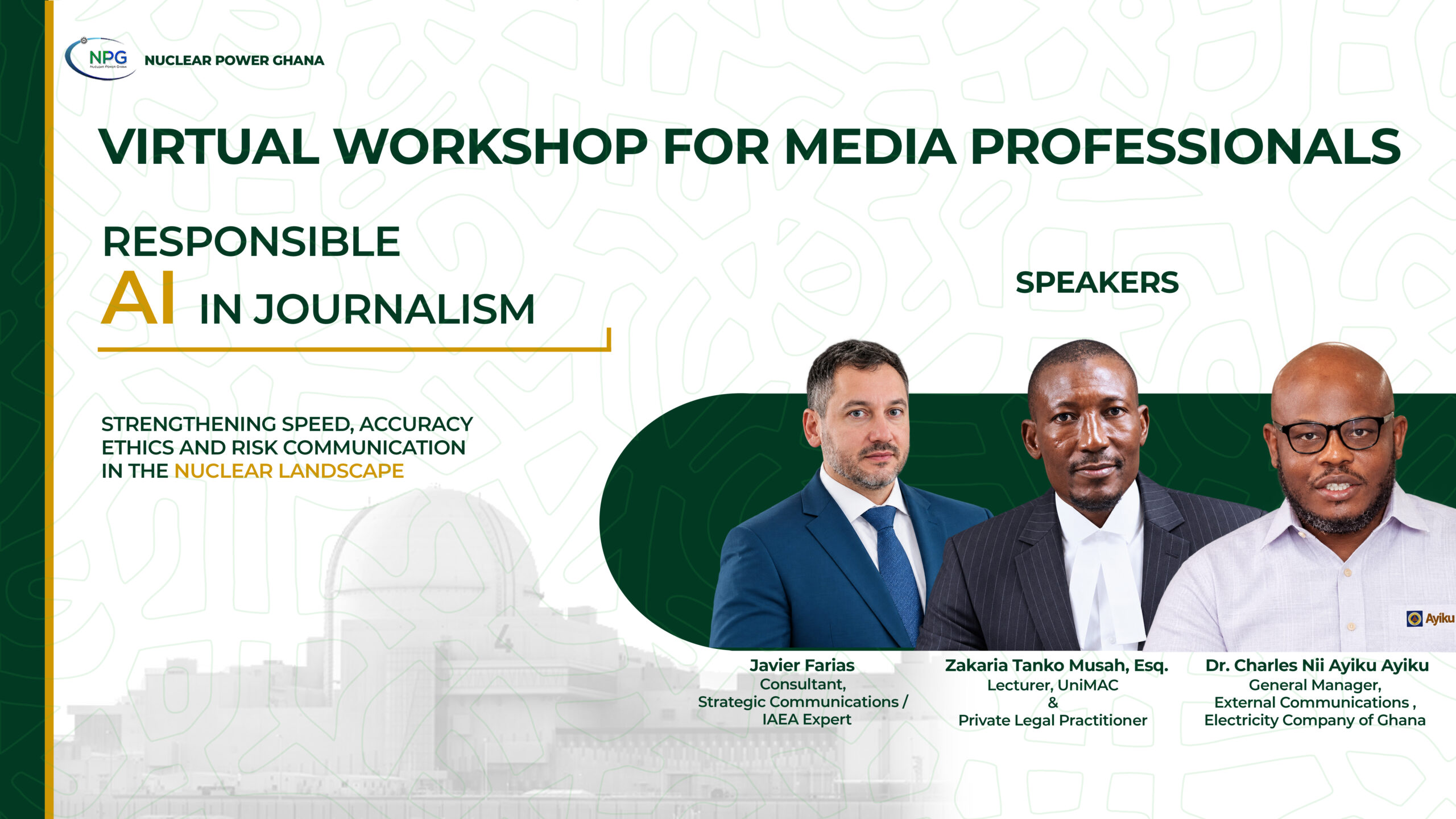
Nuclear Power Ghana has held a virtual workshop for media professionals aimed at strengthening journalists’ understanding of responsible Artificial Intelligence (AI) use in reporting on nuclear energy and related issues. The workshop, themed “Responsible AI in Journalism: Strengthening Speed, Accuracy, Ethics and Risk Communication in the Nuclear Landscape,” brought together over 70 media professionals to examine how AI can support journalism while safeguarding accuracy, accountability and public trust. Dr. Charles Nii Ayiku Ayiku, General Manager, External Communications at the Electricity Company of Ghana (ECG), said the increasing complexity surrounding nuclear issues makes responsible journalism particularly important. He identified technical complexity, misinformation, public safety, politics and money, and deep uncertainty as some of the factors that make communication about the nuclear landscape challenging. “Trust is the asset,” he stressed, highlighting the importance of maintaining public confidence when reporting on issues with significant safety and societal implications.
Understanding AI in plain language
The workshop introduced participants to key AI concepts, including artificial intelligence, machine learning, generative AI, large language models and multimodal AI. Participants were reminded that AI can occupy two roles in journalism: it can be the subject of a story and a tool used in producing the story. The workshop distinguished between AI-assisted work and editorial responsibility. AI can assist journalists with tasks such as drafting, research and analysis, but it should not replace journalists’ professional judgment.
AI and the nuclear landscape
The training explored several areas where AI is increasingly relevant to nuclear activities, including predictive maintenance, safety and reliability, emergency preparedness, anomaly detection, and radiation and environmental monitoring. According to the workshop, journalists covering these areas need sufficient technical understanding to explain developments accurately to the public without overstating what AI systems can do.
AI can assist at every stage but owns none
The workshop outlined eight stages of the reporting process where AI can provide assistance:
Research
Analysis
Verification
Interview preparation
Writing
Editing
Publishing
Monitoring
Participants were cautioned that while AI can assist at each stage, “it owns none of them.” The journalist remains responsible for the final editorial decisions and published material.
AI as a research and investigative tool
AI was described as particularly useful for research and backgrounding, which was identified as one of the fastest legitimate applications for journalists.
Journalists can use AI to become oriented on complex subjects and obtain explanations of technical concepts, but the workshop cautioned against treating AI-generated material as a source to be quoted without verification. For investigative and data journalism, AI can assist with dataset analysis, document extraction, identifying inconsistencies and organising evidence. The workshop emphasised that AI can surface potential leads, but journalism must establish the truth. A pattern identified by an AI model should therefore be treated as a reason to investigate, rather than proof of wrongdoing or a factual conclusion.
Preparing for technical interviews
AI can also help journalists prepare for interviews with technical experts by mapping an expert’s field and identifying the standard debates surrounding an issue. The objective, participants were told, is to enter an interview with enough background knowledge to ask meaningful second and third questions rather than stopping at basic explanations.
Transcription and translation require caution
The workshop also highlighted the time-saving potential of AI-powered transcription, translation and accessibility tools. However, participants were warned that these systems can be weakest precisely where journalism is most technical. Errors in specialised terminology, figures, names and scientific concepts can therefore have significant consequences for nuclear reporting.
Verification remains at the heart of journalism
Verification was described as the area where professional journalism remains indispensable. Participants were warned about common AI-related risks, including hallucinations, fabricated citations, stale information, false confidence, incorrect numbers and invented quotations. Journalists were encouraged to verify every consequential claim against authoritative sources and original documents rather than assuming that confident-sounding AI-generated information is accurate.
Accuracy goes beyond technically correct statements
The workshop further examined the importance of risk communication, noting that technical accuracy alone does not guarantee that audiences will understand a nuclear issue correctly.
A sentence may be technically defensible but still create a misleading impression among the public. Such an outcome, participants were told, can itself constitute an accuracy failure. This is particularly important in reporting on unusual radiation readings, nuclear incidents or other sensitive developments, where context and uncertainty can significantly affect how audiences interpret information.
What journalists should never outsource
The workshop identified several responsibilities that should remain firmly with journalists and editors.
These include:
Editorial judgment
Source protection
Verification of facts
Attribution and credit
Fairness and the right of reply
Public-interest decisions
Interpretation of sensitive evidence
A formula for better AI prompts
Participants were also introduced to a basic formula for constructing effective prompts when using AI in journalism.
The formula consists of:
Role + Context + Task + Source + Constraints + Output
The training contrasted weak prompts with stronger, more specific prompts, emphasising that better instructions can produce more useful AI assistance while still requiring human verification.
A responsible workflow for nuclear stories
The workshop proposed an AI-assisted workflow for reporting nuclear stories:
Define the story → Gather authoritative sources → Use AI for orientation → Identify questions and gaps → Verify the information. For example, in reporting an unusual radiation reading near a facility, journalists should verify every consequential claim, examine uncertainty, review the original document, inspect the figures and fact-check the information before publication.
Nuclear risk communication requires public assurance
A Consultant in Strategic Communications and an Expert with the International Atomic Energy Agency (IAEA) Javier Farias also addressed nuclear risk communication and public assurance. The discussion began with a fundamental public question: Is nuclear power safe? The IAEA Expert explained that hazard and risk are related but not identical. Risk assessment involves considering both the likelihood of an event and the severity of its consequences. A simplified formulation presented during the workshop was: Technical risk = Probability × Severity
Understanding public perception of nuclear risk Risk perception was described as subjective and strongly influenced by people’s feelings about radiation and nuclear technology.
Javier Farias noted that nuclear risk communication carries a particularly heavy burden because radiation is invisible and cannot be detected through ordinary human senses. Other factors include the potentially high consequences of low-probability events, long time frames associated with nuclear waste and decommissioning, the interconnected responsibilities of institutions, and the historical associations between nuclear technology, accidents and weapons.
What shapes risk perception?
Participants examined several factors that influence how people perceive nuclear risks, including:
Control
Trust
Media attention
Familiarity
Fear
Understanding
The workshop stressed the importance of translating technical terminology into language that ordinary audiences can understand. It also cautioned against dismissing public fear as merely irrational anxiety. Nuclear risk communication must treat fear as a fact about public perception that needs to be understood and addressed, while distinguishing perceptions from evidence about actual risk.
Communication must be a dialogue
The experts warned against relying on non-evidence-based claims when communicating about nuclear issues.
Effective risk communication, participants were told, should be a dialogue rather than a monologue, allowing concerns, questions and uncertainties to be acknowledged and addressed. The workshop concluded with a strong emphasis on the relationship between journalism, responsible AI use and public confidence.
The central message was that the question is no longer whether journalists will use AI, but whether they will use it responsibly enough to preserve accuracy, accountability and public trust.
As the workshop emphasised: “Trust is built before you need it.”