Misleading power supply report: Energy Ministry demands retraction from Multimedia

Misleading power supply report: Energy Ministry demands retraction from Multimedia
A storm over the airwaves
Tensions rose sharply in Ghana’s energy sector after the Ministry of Energy and Green Transition publicly challenged a report aired by Multimedia Group on JoyNews TV. The report had suggested that the country experienced significant power shortages—up to 1,000 megawatts—during March 2026. What might have been another routine media discussion quickly escalated into a national dispute over facts, credibility, and public trust.
The Ministry pushes back
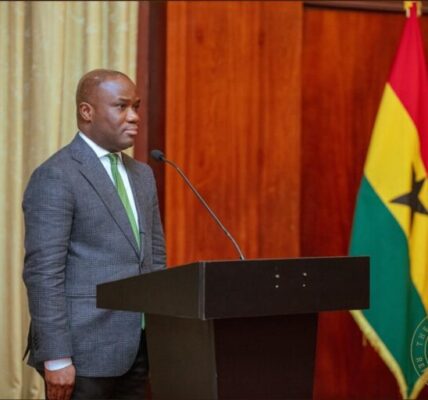
In a strongly worded letter dated April 29, 2026, the sector Minister, John Abdulai Jinapor, rejected the claims outright. According to the Ministry, the figures cited in the report were not just exaggerated—they were entirely baseless. Officials insisted that at no point during March did Ghana’s power system experience load shedding of that magnitude, or any at all as implied. The statement framed the report as a serious misrepresentation of operational realities within the country’s energy infrastructure.
Data vs. Interpretation
Beyond denying the claims, the Ministry argued that the issue went deeper than incorrect numbers. It accused the report of misunderstanding how power systems function. Routine processes—such as plant dispatch decisions and grid balancing—were allegedly misinterpreted as evidence of supply shortages. From the Ministry’s perspective, these technical nuances are critical. Misreading them, officials warned, can easily lead to false conclusions that distort the true picture of national energy stability.
Confidence at stake
The government’s concern wasn’t just about accuracy—it was about impact. According to the Ministry, the publication and the discussions that followed across Multimedia platforms risked undermining public confidence in Ghana’s power sector. At a time when energy reliability is closely tied to economic stability and investor confidence, such claims, if left uncorrected, could have far-reaching consequences.
A different narrative
In contrast to the report’s claims, the Ministry painted a far more stable picture of the situation. It stated that throughout March and April 2026, electricity generation consistently met domestic demand. In fact, Ghana reportedly had excess capacity, allowing it to export power to neighboring countries under existing regional agreements. This alternative narrative directly contradicts the notion of widespread shortages, highlighting a significant gap between the two accounts.
Questions of Journalism
The Ministry also took issue with how the report was produced. It criticized the lack of consultation prior to publication, noting that neither the Ministry nor relevant agencies were contacted for clarification. Officials described this as a breach of established protocols when reporting on critical national infrastructure. In their view, responsible journalism—especially on technical matters—requires engagement with authoritative sources to ensure accuracy.
Demands for redress
In response to the controversy, the Ministry laid out clear demands for Multimedia Group:
An immediate retraction and correction of the report with equal prominence
A formal public clarification on the true state of Ghana’s power supply
A commitment to consult relevant authorities on technical matters before future publications
These demands signal that the Ministry is not treating the issue lightly, framing it as both a factual dispute and a matter of accountability.
Despite the dispute, the Ministry reaffirmed its commitment to transparency. It expressed readiness to provide data, technical briefings, and expert insights to support informed public discussion. Whether Multimedia will comply with the demands remains to be seen. But the episode underscores a broader challenge: in an age of rapid information sharing, the line between analysis and misinformation can have real-world consequences—especially when it comes to something as vital as energy.