
Ghana Moves from Aspiration to Action
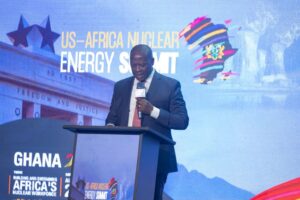
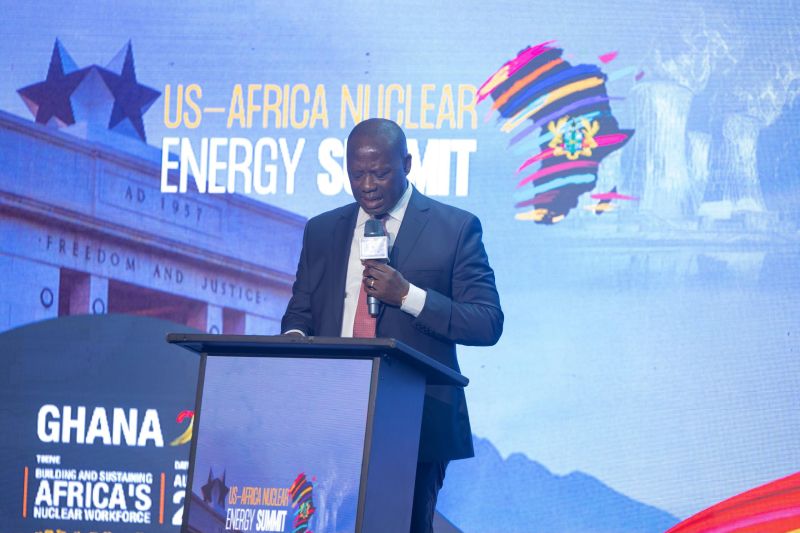
The Government of Ghana has affirmed the country’s readiness to adopt nuclear power as part of efforts to diversify the national energy mix and secure reliable and affordable electricity to drive industrialisation. Mr. Emmanuel Armah-Kofi Buah, Minister for Lands and Natural Resources and Acting Minister for Environment, Science and Technology, who represented President John Dramani Mahama at the opening of the third US-Africa Nuclear Energy Summit in Accra, said Ghana had moved beyond merely expressing interest in nuclear power and was now prepared to pursue the programme.
“We are ready. Ghana has formally entered Phase Two of the International Atomic Energy Agency’s milestone approach for developing nuclear power infrastructure,” he said.
Preparations for Nuclear Programme Advance
Mr. Buah said a number of critical preparations were already at an advanced stage, including site studies, institutional strengthening, stakeholder engagement and discussions with nuclear technology vendors.
He noted, however, that Ghana’s nuclear ambition should not focus solely on constructing a nuclear power plant. According to him, developing the human capacity required to operate and sustain the programme was equally important.
“Human capacity in itself is infrastructure. We therefore cannot build physical infrastructure today and hope to find the people tomorrow. We must build both,” he said.
Nuclear Power to Support Rising Demand
Dr. John Jinapor, Minister for Energy and Green Transition, said nuclear power would play a “cardinal” role in Ghana’s future energy mix as the country sought to meet growing electricity demand and support industrialisation. He noted that Ghana’s peak electricity demand had increased dramatically from about 300 megawatts when the Akosombo Dam was commissioned to approximately 4,500 megawatts today.
Dr. Jinapor said the country’s installed generation capacity was now dominated by thermal sources, making diversification increasingly important to Ghana’s long-term energy security. He said the government was therefore pursuing a diversified generation mix comprising natural gas, renewable energy and nuclear power to provide reliable, affordable and low-carbon electricity.
“Nuclear energy forms a critical pillar of this strategy,” he said.
Ghana Advances Under IAEA Milestone Approach
Mr. Jinapor said Ghana was making progress under the International Atomic Energy Agency’s milestone approach, with the ultimate objective of integrating nuclear generation capacity into the national electricity mix. The milestone approach provides countries considering nuclear power with a structured framework for developing the necessary legal, regulatory, technical and institutional infrastructure required for a safe and sustainable nuclear programme.
Ghana and US Deepen Nuclear Cooperation
Ghana and the United States are also making progress towards concluding a 123 Agreement on peaceful nuclear cooperation. Dr. Jinapor said the agreement had already been initialled and was awaiting the necessary approvals. The agreement is expected to provide an important framework for strengthened peaceful nuclear cooperation between the two countries as Ghana advances its nuclear energy programme.
US Commits to Building African Nuclear Capacity
Dr. Michael Goff, Principal Deputy Assistant Secretary for the US Department of Energy’s Office of Nuclear Energy, reaffirmed the United States’ commitment to supporting Ghana and other African countries developing nuclear energy programmes. He said the US had partnered with Nuclear Power Ghana to establish a Regional Energy Training Centre in Accra.
The centre provides training and technical exchanges in areas including reactor technologies, cybersecurity, quality assurance and spent fuel management.
“Our objective is not to provide individual training programmes. It is to build lasting institutional partnerships and technical capacity that can grow alongside Africa’s nuclear ambitions,” Dr. Goff said.
Summit Focuses on Africa’s Nuclear Workforce
The three-day US-Africa Nuclear Energy Summit opened in Accra on Wednesday, August 19, and ended on August 21. Held under the theme, “Building and Sustaining Africa’s Nuclear Workforce,” the summit brought together governments, industry players, academia, regulators and development partners.
Participants discussed strategies for developing the skilled workforce, institutional capacity, financing arrangements and partnerships required to support safe, secure and sustainable nuclear energy programmes across Africa.
A New Chapter for Ghana’s Energy Future
Ghana’s renewed commitment to nuclear power marks a significant step in the country’s efforts to secure its future electricity needs. With electricity demand continuing to rise, the government sees nuclear power as a potential source of dependable, low-carbon baseload electricity that can complement natural gas and renewable energy.
As Ghana progresses through the IAEA milestone process, the development of technical expertise, strong institutions and a skilled nuclear workforce will remain central to ensuring that the country’s nuclear ambitions translate into a safe and sustainable energy programme.